General Info

Just One Question                                            PHOTO GALLERY

It never ceases to amaze me how you see those fisherman in the same spot on the river time after time. I seldom fish the same spot in the river for various different reasons, one of which is that fish are always moving up and down a river system. I scratch my head in confusion as to why I see the same fisherman in the same spot constantly. As water temperatures rise and fall and their food source grows or depletes, fish will come and go as the conditions dictate. One day I will fish a hole or run and there will be many trout caught. Go back to the same spot a week later and there will be no trout caught? 

What influences this migration of fish in and out of different locations of a river system? Cover plays a very important role in this pattern. Available food supply has a big impact as well. Stream fish seek to find cover the second they hatch. These tiny fry are very small and are weak swimmers and unless they can find some type of cover to hide behind, they often get swept away by the current.

Take note here, Fish need larger pieces of cover to shade them and to conceal them as they grow. The biggest fish in a river/stream seek out the largest boulders and logs or the deepest undercut banks. Water that lacks this type of structure will usually only hold small fish! The best cover not only breaks up current, it also provides overhead protection. As a result, fish prefer slack water beneath an undercut bank to an eddy behind a boulder.

Every stream or river has several pieces of cover that I refer to as fish magnets. More often then not, these spots are inhabited by one or two of the rivers largest, most dominant fish. When you are able to catch one of these fish, another of about the same size moves in to replace it. The most consistently successful anglers on a river are those fishermen who know where several of these spots are located. This brings us back to the question I proposed earlier.

Here are some spots in a river I look for when fishing for trout. With some practice and patience you will learn to recognize these subtle visual clues that reveal their locations. Points or sharp bends of a river create major eddies. The longer the point or the sharper the bend, the larger the eddy that will form as a result. Another place to look is bridge pilings, they have eddies on the upstream and downstream ends. Quite often the cover is better than it looks because of the riprap piled at the base of the pilings to reduce erosion. And last but not least, weedbeds create a diverse current pattern and hold many types of food. Fish lie in the slow water in the beds themselves then they dart out to grab food drifting through channels between the beds. Look for these spots on any river system and you will have the upper hand on those fishermen that stand in the same spot over and over.

Gone Fishing- Bow River

A Guided Fishing Trip                PHOTO GALLERY

The clouds finally broke and the sun shone through here in trout country. I was fortunate to guide three very nice people from El Segundo, California today and we were able to catch some nice fish from the Bow River. We headed up to one of my favorite Brown Trout holes today and had some success while there. John latched into a very nice Rainbow Trout on the way up to the hole and this fish gave him a serious run for his money. He was able to battle this very hard fighter and reel him into shore where I helped him unhook the trout and take a quick photograph. The big smile on his face told the story as the trout here just seem to be a little bigger than other places in the world. His friend Josh was also able to hook into a couple of nice sized Browns as well.

My main goal today was to get Dave and the boys into some larger Bow River trout and this Rainbow was a welcomed site for both me and my clients. I try my very hardest to provide the best possible experience for my client/clients at all times. As we made our way up to the big trout hole we had a nice talk and got to know each other better. That’s the thing about guiding is you get to meet great people from all over the world. While talking with Dave I got the feeling of just how lucky we are here in Alberta to have a river system such as the Bow right out the back door.

We were able to hook some nice Browns in our destination point but today’s trout we just not hitting as hard as I have seen in the past and kept popping off our laser sharp hooks. I guess every fisherman has his day, but it would have been nice for me to see Dave pull one of those bigger fish he had on into the shoreline. Never the less I had a blast guiding these great people today and I hope they share the same feelings as we parted company. I hope to see you back again Dave as there are bigger trout here just for you. Thank you so much for letting me be of service to you today.

Fishing Etiquette- Where Has It Gone

I Could Not Have Said It Any Better

Fishing etiquette, sometimes I have to wonder if anyone’s ever heard of such a thing. The word etiquette is defined as: The forms required by good breeding, or prescribed by authority, to be observed in social or official life; observance of the proprieties of rank and occasion; conventional decorum; ceremonial code of polite society.

So why is it that as soon as I get on a river, I invariably end up fishing near someone who has never heard the above definition? It seems as if as soon as people get into a fishing situation, all rules of society are thrown out the window and it becomes a free for all. I mean it says, right in the definition, ‘ceremonial codes of polite society’. When it comes to fishing, especially on a river, one of those ‘ceremonial codes of polite society’ is to allow other anglers there personal space just as you would afford them in any other social situation. I mean, for God’s sake, just because were out on the river fishing it doesn’t mean that we have to become complete inconsiderate idiots, does it?

I’m of course referring to a situation that I got caught up in, not too long ago, on one of my local rivers. I had been fishing along a very nice stretch of water for about twenty minutes, when a couple of other fishermen came walking along the river. They kept there distance as we exchanged friendly glances, and they began fishing about fifty yards from where I was.

This is how things are supposed to work when two anglers meet on a river. But then I caught a fish. Then another one and this second fish was quite nice. A nice eighteen to twenty inch Rainbow. I released the fish and went on about my business, continuing to fish this nice stretch of river, which incidentally was no bigger, the average driveway.

The next thing I knew, the other fishermen were in my freakin’ back pocket! I mean these guys surrounded me like I was trying to do something horrible to one of their children. Then the interrogation started. What are you using? How big was that fish? Do you always catch fish here? This is what I’m talking about when I speak of fishing etiquette. When I’m out on the river, and I’m sure most people would agree, I want to relax, enjoy nature, and if I can manage it, catch a few fish. I don’t need to give a fishing lesson to anyone. And, as far as I’m concerned, no one needs to give one to me. If I see you on the river and you catch a nice fish, good for you. I might give you a thumb’s up or something, but that’s all the information we need to exchange.

I’ve never understood why people think that if a fish is caught out of a spot, that’s the only place on a given stretch of water that contains fish. And the spot or area that they’re fishing doesn’t! That’s the only explanation as to why these two guys muscled up on me like a bully on the smaller kids in the schoolyard. They had to think that they had a better chance of catching a fish where I had just caught a fish than where they were originally fishing. And just to clear the air, this is not the case. It’s a fallacy, and this kind of behavior needs to stop.

Give other anglers the space they need to fish when you’re out on the river. Using a little fishing etiquette out on the water will make our sport better for all of us. As I eluded to earlier, just afford people the same courtesy you would on a busy elevator. Just because were standing in a river, it doesn’t mean we can’t practice basic etiquette.

Trevor Kugler – Co-founder of JRWfishing.com Trevor has more than 20 years of fishing experience, and now specializes in ultralight trout fishing.

Brown Trout Info

History of The Brown Trout
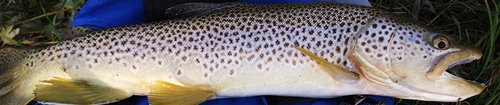
Scottish Brown Trout

Just when the divergence between the Atlantic salmon(salmo salar), and the brown trout(salmo trutta), occured is unknown, but there is large scientific evidence showing that they have a common ancestor. Recently found chromosome differences between the Atlantic salmon(56-58) and Salmo trutta(80) clearly separate the salmon and brown, but the similarity of the markings of the juveniles and parr (yearlings and fry) are strong evidence of a recent heritage.

Behnke’s recent research show that both brown and salmon have the same amount of DNA(weight). If the brown trout evolved by partial chromosome doubling, it should have 40% more DNA. Because the amount is approximately the same for both, it seems that the brown trout is the ancestral form and the Atlantic salmon is derived from it, by fusion of some of the chromosomes. The salmon has many long one-armed chromosomes, apparently a fusion of two-arm brown chromosomes.

The brown trout is an extremely polymorphic species. This fish adapts very quickly to the environment that it lives in. During the ice age (prior to the great flood), most of the British Isles and Northern Europe were covered with ice, and almost all freshwater fishes would have been eliminated in the regions of glaciation. There are a few isolated brown trout populations that are still present today up in the mountains. They have found these isolated distinct populations by measuring the genetic marker LDH eye enzeme.

The ice forced the brown trout southward, permitting these forms to invade the Mediterranean, Black, and Caspian seas. The glaciation was not continuous, however, and alternate advances and retreats of ice (along with the brown trouts repopulation in accesible locations) and separate geographical areas, most likely resulted in long periods of genetic isolation, allowing genetic differentiation to take place. Thus, the different types of brown trout.

CLASSIFICATION

There is considerable genetic diversity among brown trout populations of north-western Europe with any indiviual population containing only a limited part of the genetic variation present in the species(Freguson 1989). There are even distinctive, reproductively isolated sympatric populations present(in Sweden, Ireland, and Spain). This is why, at one time, there were as many as 50 separate “species” of brown trout.

Lets look at the history of the classification. Carlolus Linnaeus, in his historical work “Systema Naturae”, published in 1758, named three types of trout in Sweden by the binomial nomenclature now universally used; S.trutta, the trout of large rivers; S.fario, the trout of small brooks; and S.criox, the migraratory sea trout. Then in Gunthers 1866 “Catalog of Fishes in the British Museum” described 10 species of brown trout from the British Isles that deserve special attention because of recent phylogenetic and taxonomic studies.

These are; the river trout(s.fario), sea trout(S.trutta); great lakes trout(S.ferox), Loch Leven trout(S.levenensis), Welsh black-finned trout(S.nigripinnis) see picture, the Irish gilaroo,(S.stomachicus), the western sea trout(S.cambricus), the eastern sea trout(S.brachypoma), the Galaway sea trout(S.gallivensis), and the Orkney sea trout(S.orcadensis). By 1930 David Jordan, Carl Hubbs, and others argued that the separate species should all be accorded one name “Salmo trutta L.” and had been accepted by virtually all taxonomists as the proper name for the various forms and descriptions of brown trout. So, that’s the end of our story, wrong…

In 1932, L.S. Berg, a highly respected Russian authority of fishes of Eurasia, agreed that all forms of brown trout deserved to be recognized as belonging to one species, but saw enough differences in geographical subdivisions to recognize six subspecies stemming from geographical separation: northern and western Europe(Salmo trutta trutta), Black Sea and trib.(S.t.caspius), Caspian Sea and trib.(S.t.caspius), Mediterranean region(S.t.macrostigma), Lake Garda, Italy(S.t.carpio), and Sea of Aral and Amu Dar’ya River(S.t.aralensis).

INTRODUCTION TO NORTH AMERICA

Brown trout (salmo trutta) are not native species to North America. The first documented introduction og brown trout was on April 11, 1884, J.F.Ellis stocked 4,900 brown trout fry(von Behr strain) into Michigan’s Pere Marquette River. After this initial distribution in 1884, distribution of brown trout was swift and wide. The first North American introduction of Loch Leven trout, Salmo trutta levenensis (a lake form), appears to be made in Long Pond near Saint John’s, Newfoundland, in 1884. The sea run strain (S. t. trutta) was also introduced around this time but, the only currently known strain exists in Nova Scotia and Massachusetts.

After the first North American introduction of the Lock Leven (see picture) trout occured in 1884, brown trout were introduced into every province except Prince Edward Island. Incredibly, there was little or no attempt to keep the Lock Leven and the von Behr strains isolated or distinct. Goverment and private fish distribution records listed both types, but widespread shipment from one hatchery to another (crossbreeding), and the introduction of both strains into the same waters apparently resulted in the merging of the original distinguishing characteristics. Perhaps we should now discuss the differences between the two strains. . The von Behr trout, (S. fario) lived in small streams, were brightly coloured, and rarely exceeded the lenght of 12 inches.

In contrast, the Loch Leven trout, (S. levenensis), was a lake-dwelling form, silvery gray with black spots, reaching a size of 18 lbs. If, as reported, the von Behr and Loch Leven strains have been widely interbred and broadly distributed, and if the brown trout has a plastic genetic ability(polymorphic), I’m not surprised that North American brown trout are, in appearance and life history, similar to practically every form originally described in Europe. All three different types of brown trout were introduced into our waters during the 1800’s, but recently C. Krueger and B. May discovered that the populations are becoming genetically differentiated. This is extremely important for fisheries managers. They studied the allozyme data of brown trout from Lake Superior and came to some interesting conclusions.

The differentiation among hatchery stocks was 2.2 times greater than that observed among the 8 samples from wild populations. Similarly, the differentiation between the two groups (hatchery and wild) was also larger than that observed amomg samples from wild populations. They also found that the level of differentiation observed in Europe appeared to be greater than that observed in Lake Superior, but the amount of differentiation was highly significant because of their so recent introduction. The existance of multiple brown trout stocks in Lake Superior implied that reproduction-isolating mechanisms occur among populations of brown trout. They are also quickly adapting to their enviroment(polymorphic) through genetic selection.

Ryman (1981) noted a general tendency of brown trout from European waters “to aggregate into close and genetically distinct populations.” They concluded that the genetic differences could be due to 1) to rapid rate of population differentiation since stocking through the effects of small founding populations coupled with assortative mating based on precise homing behavior, or 2) to the partial preservation of the original genetic characteristics of the different European stocks that were introduced into the basin. Personally, I think that both factors are present.

By Wayne Sheridan
